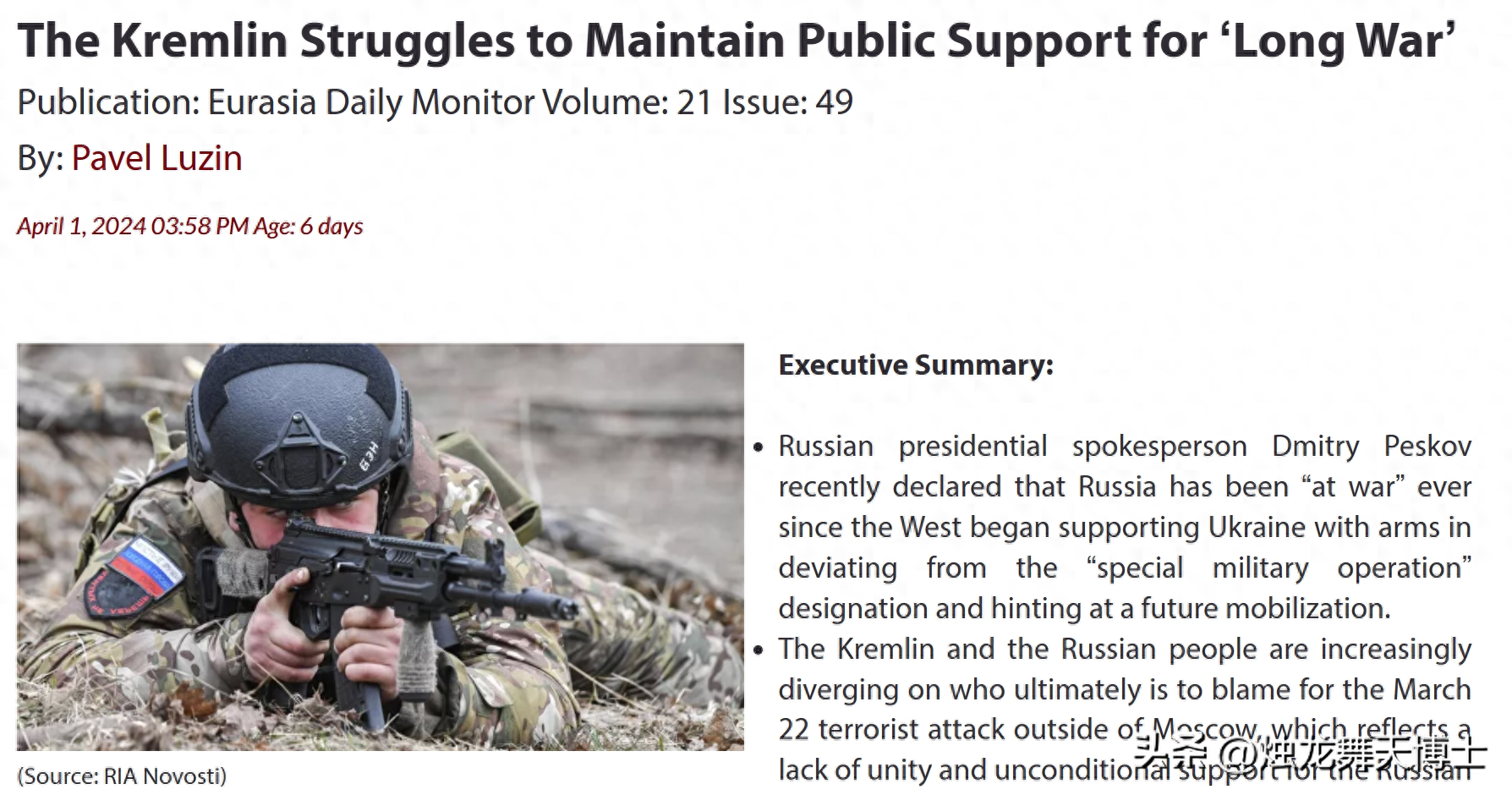
ExecutiveSummary摘要:
俄罗斯总统发言人德米特里·佩斯科夫最近宣布,自从西方开始用武器支持乌克兰,偏离“特别军事行动”的指定,并暗示未来将进行动员以来,俄罗斯一直处于“战争”状态。
克里姆林宫和俄罗斯人民在谁应为3月22日莫斯科郊外的恐怖袭击承担最终责任的问题上分歧越来越大,这反映出俄罗斯领导人的言论缺乏团结和无条件支持。
这种不和谐预示着俄罗斯国内将出现进一步的政治动荡,不仅在民众和弗拉基米尔·普京之间,而且在俄罗斯人民之间。
RussianpresidentialspokespersonDmitryPeskovrecentlydeclaredthatRussiahasbeen“atwar”eversincetheWestbegansupportingUkrainewitharmsindeviatingfromthe“specialmilitaryoperation”designationandhintingatafuturemobilization.
TheKremlinandtheRussianpeopleareincreasinglydivergingonwhoultimatelyistoblamefortheMarch22terroristattackoutsideofMoscow,whichreflectsalackofunityandunconditionalsupportfortheRussianleadership’srhetoric.
ThisdissonancepromisesfurtherdomesticpoliticalturmoilinRussia,notonlybetweenthepopulationandVladimirPutinbutalsoamongtheRussianpeoplethemselves.
克里姆林宫关于在克拉斯诺戈尔斯克造成140多人死亡的“伊斯兰国”恐怖袭击与乌克兰领导层之间关系的令人不安的言论可能有一个解释。莫斯科主要担心俄罗斯人民对国内政治议程和对乌克兰的“长期战争”越来越漠不关心。克里姆林宫继续努力激励和动员更多的人支持战争努力和日益极权主义的国内实验,而不会有失去对局势控制的风险,尤其是在俄罗斯族人占主导地位的城市中心。
TheKremlin’sdisturbingrhetoricaboutthetiesbetweentheIslamicState(IS)terroristattackthatkilledmorethan140peopleinKrasnogorskandUkrainianleadershiphasalikelyexplanation(seeEDM,March26,28).MoscowisprimarilyworriedabouttheRussianpeople’sgrowingindifferencetothedomesticpoliticalagaandthe“longwar”tosupportthewareffortandtheincreasinglytotalitariandomesticexperimentwithouttheriskoflosingcontroloverthesituation,especiallyintheethnicallyRussian-dominatedcitycenters(seeEDM,March11,19,25).
3月22日,在恐怖袭击发生前几个小时,俄罗斯总统发言人德米特里·佩斯科夫表示,俄罗斯正在与乌克兰和西方集体“交战”。佩斯科夫的声明偏离了克里姆林宫为描述扩大入侵而坚持的“特别军事行动”名称。佩斯科夫认为,战争本身始于西方开始向乌克兰提供武器和其他军事援助,这是一个模棱两可的说法,因为西方在全面入侵开始之前就一直在向乌克兰提供军事援助。他补充说,俄罗斯的每个人都应该接受这一事实,并开始为“内部动员”做准备。俄罗斯发言人得出结论,对乌克兰的战争不会很快结束,俄罗斯人必须接受这一前景和由此产生的代价。佩斯科夫的声明是向国际社会发出的另一个信息,即俄罗斯不会在外国压力面前放弃。Crocus市政厅袭击事件发生后,俄罗斯领导层详细阐述了这一逻辑,并试图在恐怖分子与乌克兰和西方之间制造人为的联系。
OnMarch22,severalhoursbeforetheterroristattack,RussianpresidentialspokespersonDmitryPeskovstatedthatRussiais“atwar”’sstatementdeviatedfromthe“specialmilitaryoperation”designamsandothermilitaryaidtoUkraine,whichisanambiguousclaim,astheWesthasbeensingUgfor“inwardmobilization.”TheRussianspokespersonconcludedthatthewaragainstUkrainewillnotanyt’sstatementwasanothermessagetotheinternationalcommunitythatRussiawillnotgiveupinthefaceofforeignpressure(Argumentyifakty,March22).FollowingtheCrocusCityHallattack,theRussianleadershiphaselaboratedonthislogicandattemptedtomanufactureanartificialconnectionbetweentheterroristsandUkraineandtheWest(TASS,March25;Interfax,March26;RIANovosti,March26).
这些声明证实了俄罗斯领导层对国内舆论趋势的担忧。因此,克里姆林宫试图重新控制公众情绪。莫斯科面临的一个关键问题是,人民对克里姆林宫的政治和军事议程越来越漠不关心。最近的总统选举表明,克里姆林宫控制着俄罗斯各级官僚机构。然而,反克里姆林宫的俄罗斯准军事部队最近在别尔哥罗德和库尔斯克地区的突袭并没有在俄罗斯社会引起共鸣,也没有任何迹象表明在国旗周围有民众巩固的迹象。虽然俄罗斯人不愿提及此事,但他们确实在社交媒体上公开讨论了恐怖袭击。克里姆林宫官员试图将人民与袭击受害者短暂的团结转化为围绕国旗和战争的号召,但效果有限。
Thesestatementsconfirmthat,’sgrowingindifferencetotheKremlin’salllevelsoftheRussianbureaucracy(seeEDM,March19).Therecentraidsbyanti-Kremlin,RussianparamilitaryunitsintheBelgorodandKurskregions,however,didnotresonateinRussiansociety,,’sshort-livedunitywithvictimsoftheattackintoarallyingcryaroundtheflagandthewarbuthashadlimitedeffectiveness(,March28).
与瓦格纳集团2023年6月的未遂兵变类似,俄罗斯安全部门对恐怖袭击的反应清楚地表明,在没有明确命令的情况下,内部功能持续失调,缺乏履行职责的准备。再加上俄罗斯人民的冷漠,这种专业精神的缺乏对克里姆林宫来说不是好兆头。尽管军队、警察、安全人员和普通民众几乎没有公开抵制莫斯科的政策,但缺乏基层动力、团结和意识形态灌输将损害弗拉基米尔·普京政权继续战争及其对俄罗斯的极权主义治理的努力。
SimilartotheWagnerGroup’sattemptedmutinyinJune2023,theRussiansecurityservices’responsetotheterroristattackclearlydemonstratedongoinginternaldysfunctionandalackofpreparationtoexecutetheirdutiesintheabsenceofclearorders(seeEDM,March3;Meduza,March26).CoupledwiththeRussianpeople’sindifference,’spoliciesamongthemilitary,police,securitypersonnel,andgeneralpopulation,alackofgrassrootsmotivation,unity,andideologicalindoctrinationwillhurttheVladimirPutinregime’seffortstocontinuethewaranditstotalitariangovernanceofRussia.
克里姆林宫将无法依靠俄罗斯人民对乌克兰和西方的进一步言辞升级,因为民众对战场上的事态发展基本上漠不关心,包括在别尔哥罗德和库尔斯克。即使是忠于克里姆林宫的观察家们也认识到,“招募合同兵的潜力正在下降”,俄罗斯需要的不仅仅是“缓和的政治、军事和工业措施”。
TheKremlinwillbeunabletorelyontheRussianpeopleforfurtherrhetoricalescalationagainstUkraineandtheWestbecausethepopulationislargelyapathetictodevelopmentsonthebattlefield,“thepotentialofrecruitingcontractsoldiersisdecreasing”andthatRussianeedssomethingmorethan“palliativepolitical,military,andindustrialmeasures”(,February23).
动员人口和国内经济的问题解释了佩斯科夫为什么使用“战争”一词而不是“特别军事行动”。这些问题也支持了普京、俄罗斯联邦安全局局长亚历山大·博尔特尼科夫和俄罗斯安全委员会秘书尼古拉·帕特鲁舍夫的声明,即基辅引发了“伊斯兰国”在克拉斯诺戈尔斯克的恐怖袭击。无论克里姆林宫增加税收,引入新一波“部分动员”,将资产国有化,还是对人民和经济进行全面动员,莫斯科都需要积极和无条件的公众支持和团结。
ProblemswithmobilizingthepopulationandthedomesticeconomyexplainwhyPeskovusedtheterm“war”insteadof“specialmilitaryoperation.”ThoseissuesalsoundergirdthepronouncementsfromPutin,RussianFederalSecurityServiceheadAlexanderBortnikov,andSecretaryoftheRussianSecurityCouncilNikolaiPatrushevthatKyivinspiredtheISterroristattackinKrasnogorsk(seeEDM,March28).WhethertheKremlinincreasestaxes,introducesanewwaveof“partialmobilization,”nationalizesassets,orconductsatotalmobilizationofthepeopleandtheeconomy,Moscowneedsactiveandunconditionalpublicsupportandunity.
目前,情况并非如此,因为克里姆林宫和民众之间的不和谐明显在增长。当俄罗斯官员试图将恐怖袭击归咎于乌克兰时,俄罗斯社会指责散居国外的塔吉克人和那些“看起来”不像斯拉夫人的人。普京甚至试图平息这些沙文主义的公众情绪。因此,缺乏长期的爱国主义公众团结对克里姆林宫来说是一个重大挑战。尽管大多数俄罗斯公民仍然支持俄罗斯武装部队,几乎不准备放弃在乌克兰的被占领土,但他们不准备加入战斗,并在支持莫斯科发起进一步的作战行动方面犹豫不决。这种日益严重的不和谐预示着俄罗斯国内将出现进一步的政治动荡。
Currently,thisissimplynotthecase,RussiansocietyblamestheTajikdiasporaandthosewhodonot“look”(,March26;,March27).Consequently,thelackofloarehardlyreadytogiveupoccupiedterritoriesinUkraine,theyarenotpreparedtojoininthefightingandhesitatetosupportMoscow’sinitiationoffurthercombatoperations(,March5).ThisgrowingdissonancepromisesfurtherdomesticpoliticalturmoilinRussia.
TheKremlinStrugglestoMaintainPublicSupportfor‘LongWar’Publication:EurasiaDailyMonitorVolume:21Issue:49By:PavelLuzinApril1,2024
TheKremlinStrugglestoMaintainPublicSupportfor'LongWar'-Jamestown
烛龙舞天博士编译。
免责声明:本文章如果文章侵权,请联系我们处理,本站仅提供信息存储空间服务如因作品内容、版权和其他问题请于本站联系